
 Menu
Menu  Close
Close Bullet AI is committed to understanding and minimising the environmental impact of our AI-powered services. We believe that being honest about the environmental cost of AI — and actively working to reduce it — is part of responsible AI deployment.
Our environmental footprint
Bullet AI is a fully remote, cloud-first organisation with no physical office. Our environmental footprint is materially smaller than that of a comparable office-based company. Our products are software-only services — no bespoke hardware, kiosks, or on-site equipment is required for councils or residents to use them.
The primary environmental impact of our AI services comes from the energy consumed by cloud data centres during AI inference — the process of generating responses to user queries. This energy consumption produces associated carbon emissions and water usage from data centre cooling.
How we measure it
We have developed an AI environmental impact estimation methodology that calculates the energy consumption (kWh), carbon emissions (kgCO2e), and water usage (litres) associated with our AI-powered services. This methodology draws on published academic research into large language model energy consumption and UK government greenhouse gas conversion factors.
We are transparent about the limitations of this approach. Neither OpenAI nor Anthropic — the AI model providers we use — currently publish per-token energy, carbon, or water figures. Our estimates are based on the best available third-party research and are directional indicators, not precise measurements. We clearly label all figures as estimates and publish our methodology so it can be scrutinised.
The Sustainability Impact Calculator
To support transparency, we are developing a Sustainability Impact Calculator that estimates the environmental footprint of AI conversations on our platform. For each product, it calculates estimated energy consumption, carbon emissions, water usage, and equivalent comparisons (such as kilometres driven) based on actual usage data and published research parameters.
This tool is designed to give our clients and stakeholders a clear, honest picture of the environmental cost of AI-enabled services — and to help us track and reduce that impact over time.
The calculator is currently an internal tool and its outputs should be treated as directional estimates. We intend to make it available to clients as the underlying data and methodology mature.
What our AI services avoid
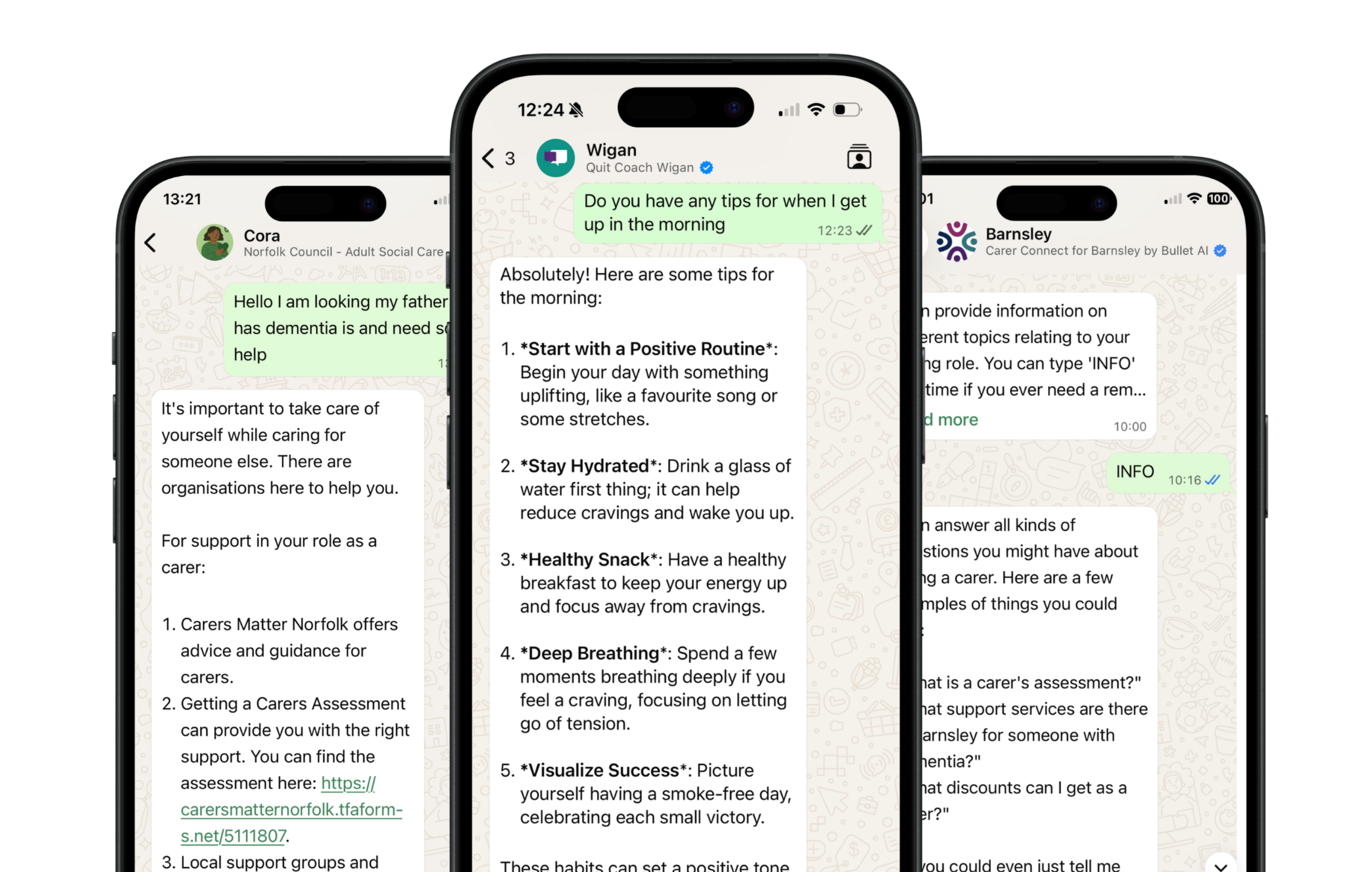
While AI inference does consume energy, our products are designed to replace or reduce reliance on more resource-intensive ways of delivering the same information. Residents who use AIDA or Quit Coach via WhatsApp may otherwise have needed to travel to a council office, wait for a telephone call-back, or receive printed material. Our services run on devices people already own, using messaging infrastructure that already exists at scale.
We have not yet formally quantified these avoided impacts for each product and do not wish to overstate this benefit without supporting data. Developing robust comparator data — in partnership with our council clients — is an active area of work.
Infrastructure choices
Our cloud infrastructure is hosted on AWS in the London (UK) region. AWS has committed to powering its operations with 100% renewable energy. AI model inference is provided by OpenAI and Anthropic via API, meaning we benefit from these providers’ data centre efficiency and renewable energy commitments without operating our own inference hardware.
Brava’s model-agnostic architecture means we can route to more efficient AI models or providers as they become available, without re-engineering the platform.
Our commitments
We commit to continuing to estimate and publish the environmental impact of our AI services using the best available methodology, to being honest about the limitations of those estimates, to actively seeking ways to reduce the energy intensity of our products, and to supporting our clients with the environmental information they need for their own sustainability reporting and procurement processes.
Our full environmental commitments are set out in our Sustainable Development Policy. If you would like more information about the environmental impact of our services, please contact us.
Ready to see the future of public service?
Get access to a demo to experience our secure AI solutions. You’ll get to see exactly how they work and choose which product you’d like to dive into.